Overview
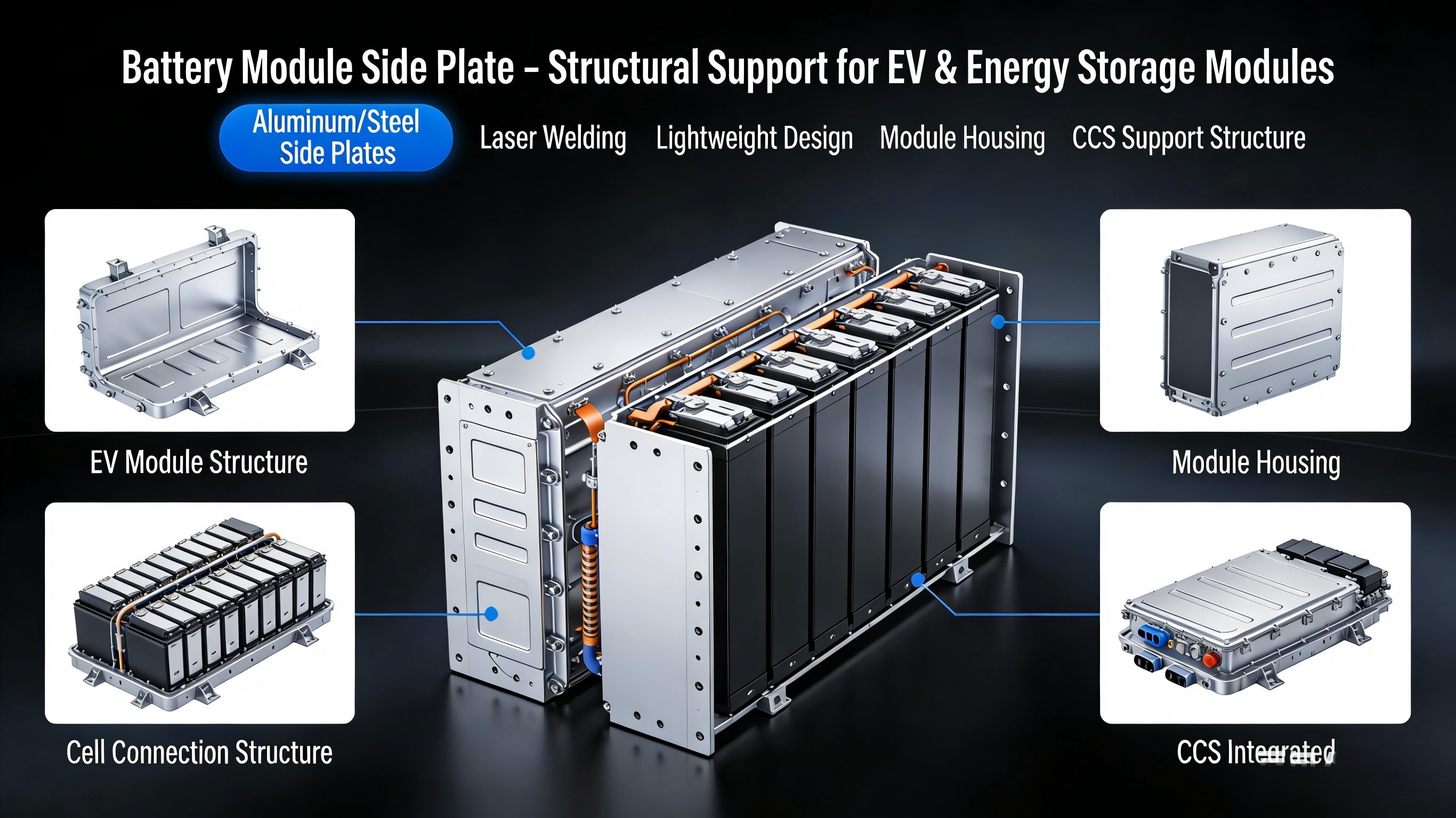
The Module Side Plate is a structural component used in EV and energy storage battery modules to provide mechanical rigidity and protection. Typically made from aluminum or steel, these plates are laser-welded or bonded to the module ends, securing the cells and CCS assembly in place. Designed for lightweight and high-strength requirements, the side plates contribute to the overall safety and durability of the battery pack under vibration and impact conditions. Customizable in thickness, material, and surface finish to meet specific module designs.
Material Selection
Weight Sensitivity: Aluminum is preferred for EV applications where reducing overall battery pack weight is critical.
Mechanical Load: Steel is selected when modules are subjected to high vibration or mechanical impact.
Thermal Management: Aluminum offers better heat dissipation, beneficial for high-current modules.
Cost Efficiency: Steel provides a lower-cost option for stationary energy storage systems where weight is less critical.
Electrical Insulation: Insulation coating is required when the side plate is in close proximity to busbars or cell terminals to prevent unintended electrical contact.
Welding Preparation
Surface Preparation
Aluminum oxides must be removed by mechanical brushing or chemical cleaning. Steel surfaces should be free of rust or zinc residues to prevent porosity.
Joint Fit-Up
Gap tolerance must be maintained at ≤0.1mm for laser welding and ≤0.3mm for resistance welding to ensure consistent penetration and fusion.
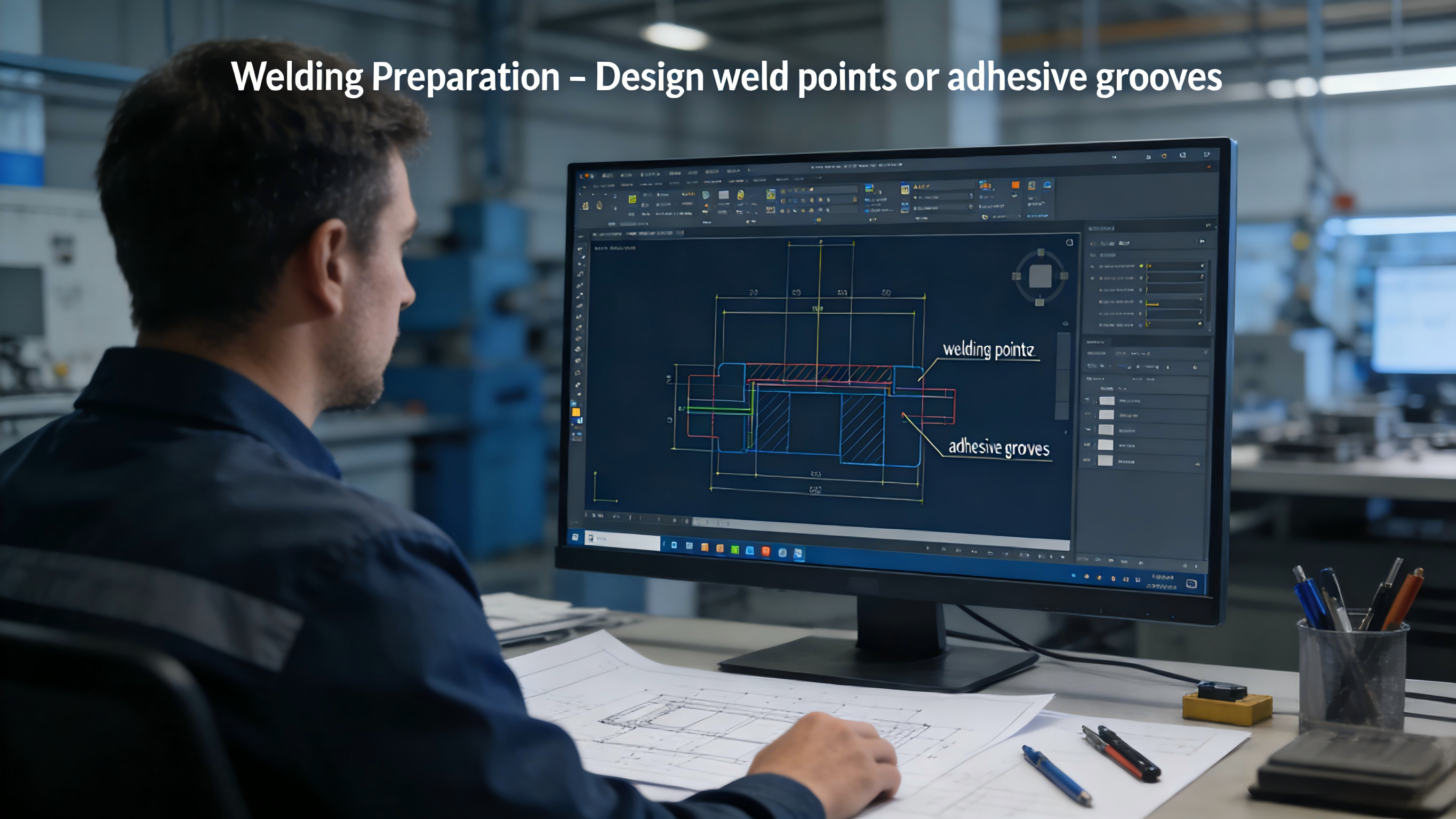
Weld Point & Groove Design
Weld points or adhesive grooves are precisely designed based on module strength requirements and assembly sequence.
Hybrid Bonding
When combining welding with adhesive, welding is performed first to avoid thermal degradation of the adhesive.
Workflow
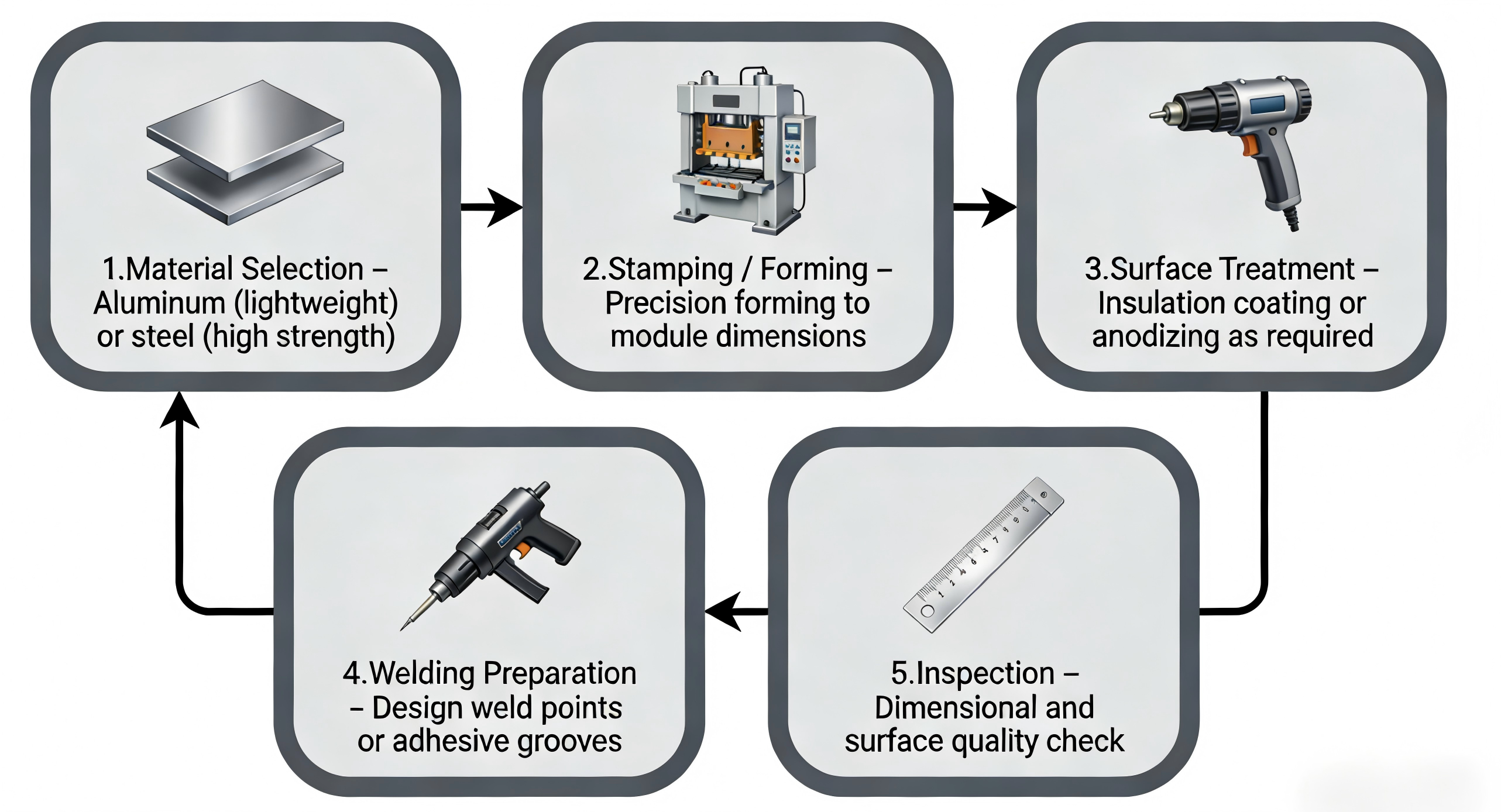
Material Selection – Aluminum (lightweight) or steel (high strength).
Stamping / Forming – Precision forming to module dimensions.
Surface Treatment – Insulation coating or anodizing as required.
Welding Preparation – Design weld points or adhesive grooves.
Inspection – Dimensional and surface quality check.
Specifications
| Parameter | Description |
| Material | Aluminum (6063, 6061), Steel (DC01, SPCC) |
| Thickness | 0.8mm – 3.0mm (customizable) |
| Surface Treatment | Insulation coating, anodizing, or bare |
| Connection | Laser welding, structural adhesive, or bolts |
| Applications | EV battery modules, energy storage modules |
Product Showing
Maintenance
Inspect weld points for integrity after assembly.
Ensure surface insulation is intact to prevent electrical contact.
Verify dimensional fit before module final assembly.