Overview
The Cells Contact System (CCS) integrates busbars, voltage sampling wires, and temperature sensors into a single assembly for EV and energy storage battery modules. This modular solution simplifies battery pack assembly, improves reliability, and enables real-time monitoring of cell voltage and temperature. The busbars are typically nickel-plated copper or aluminum, while flexible printed circuits (FPC) or wire harnesses provide signal transmission. CCS enhances safety by enabling early detection of abnormalities and reduces manufacturing complexity compared to traditional discrete wiring.
Workflow
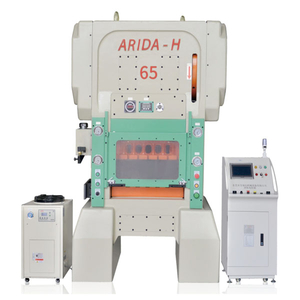
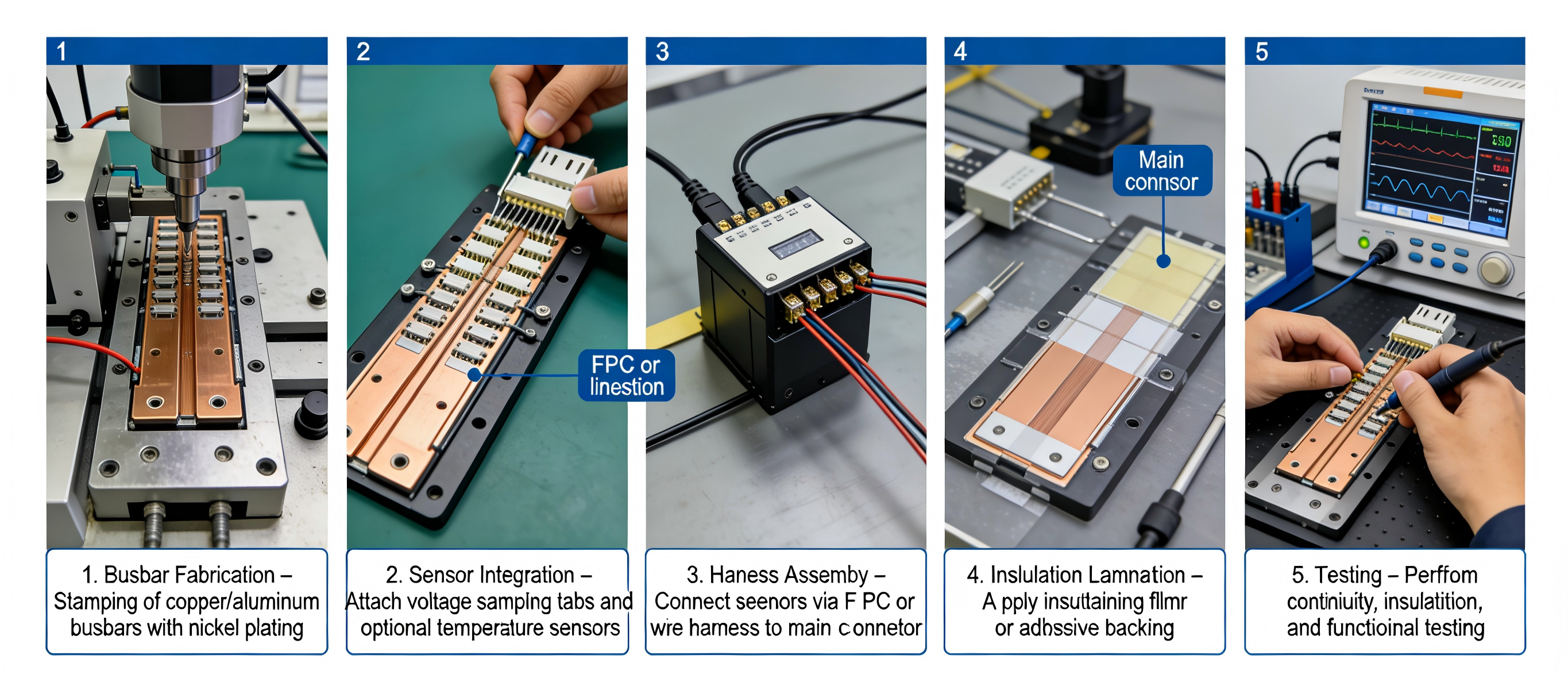
Busbar Fabrication – Stamping of copper/aluminum busbars with nickel plating.
Sensor Integration – Attach voltage sampling tabs and optional temperature sensors.
Harness Assembly – Connect sensors via FPC or wire harness to main connector.
Insulation Lamination – Apply insulating film or adhesive backing.
Testing – Perform continuity, insulation, and functional testing
Testing
Technical Specifications
| Parameter | Description |
| Busbar Material | Copper, Aluminum (nickel-plated) |
| Sensing Type | Voltage sampling, optional NTC temperature sensor |
| Connection | FPC, wire harness, or rigid PCB |
| Insulation | PET film, PI film, or adhesive insulation |
| Applications | EV battery modules, energy storage battery packs |
Application
❓ FAQ
Q: What is the advantage of CCS over traditional wiring?
A: CCS reduces assembly time, eliminates wiring errors, and provides a compact, reliable sensing solution.
Q: Can CCS include temperature sensors?
A: Yes, NTC thermistors can be integrated into the assembly for cell temperature monitoring.